Can AI handle angry customers?
Emotional conversations are where automation is most likely to make things worse. Here is what AI can safely do with an upset customer, what it should never attempt, and how to draw the line.
Operations · 21 July 2026 · 6 min read · By The OctaDezx team, Builders of the OctaDezx AI customer care platform
Key takeaways
- AI can do four things well here: notice anger early, stay calm, reply instantly and gather details before a person takes over.
- It should never decide goodwill or refunds outside policy, argue, offer scripted sympathy, or keep handling a customer who asked for a human.
- The critical capability is recognition and routing, not empathy.
- A handover must carry the full transcript, order and history, so the customer never explains themselves twice.
- Much of what makes customers angrier is waiting. An instant, calm acknowledgement removes real heat before a human even arrives.
If there is one place people are right to be cautious about automation, it is the angry customer. Emotional conversations are high stakes and easy to get wrong, and a tone deaf automated reply to someone who is already upset can turn a recoverable problem into a public one.
So the honest answer to whether AI can handle angry customers is: it can do some specific things very well, it should never attempt others, and the whole art is knowing which is which.
What AI can genuinely do well here
There are parts of handling an upset customer that AI is actually suited to, some of them better than a stressed human on a bad day.
- Notice the anger early, from the wording, and change how it responds
- Stay calm and never escalate the tone, because it has no ego to defend and does not take it personally
- Respond instantly, so the customer is not left stewing while a queue clears
- Acknowledge the problem clearly and gather the essentials before a person takes over
What it should not try to do
Equally there is a pile it should stay away from. The failure here is an AI that tries to resolve an emotional situation it cannot judge, usually by being cheerfully wrong.
- Make a goodwill or refund decision that sits outside the written policy
- Argue, explain why the customer is mistaken, or defend the business
- Offer sympathy so scripted it reads as hollow, which makes anger worse
- Keep handling it alone once it is clear the person wants a human
With an angry customer the goal is not for the AI to win the conversation. It is to take the heat out of it fast and get it to a person before it hardens.
The move that matters: recognise and route
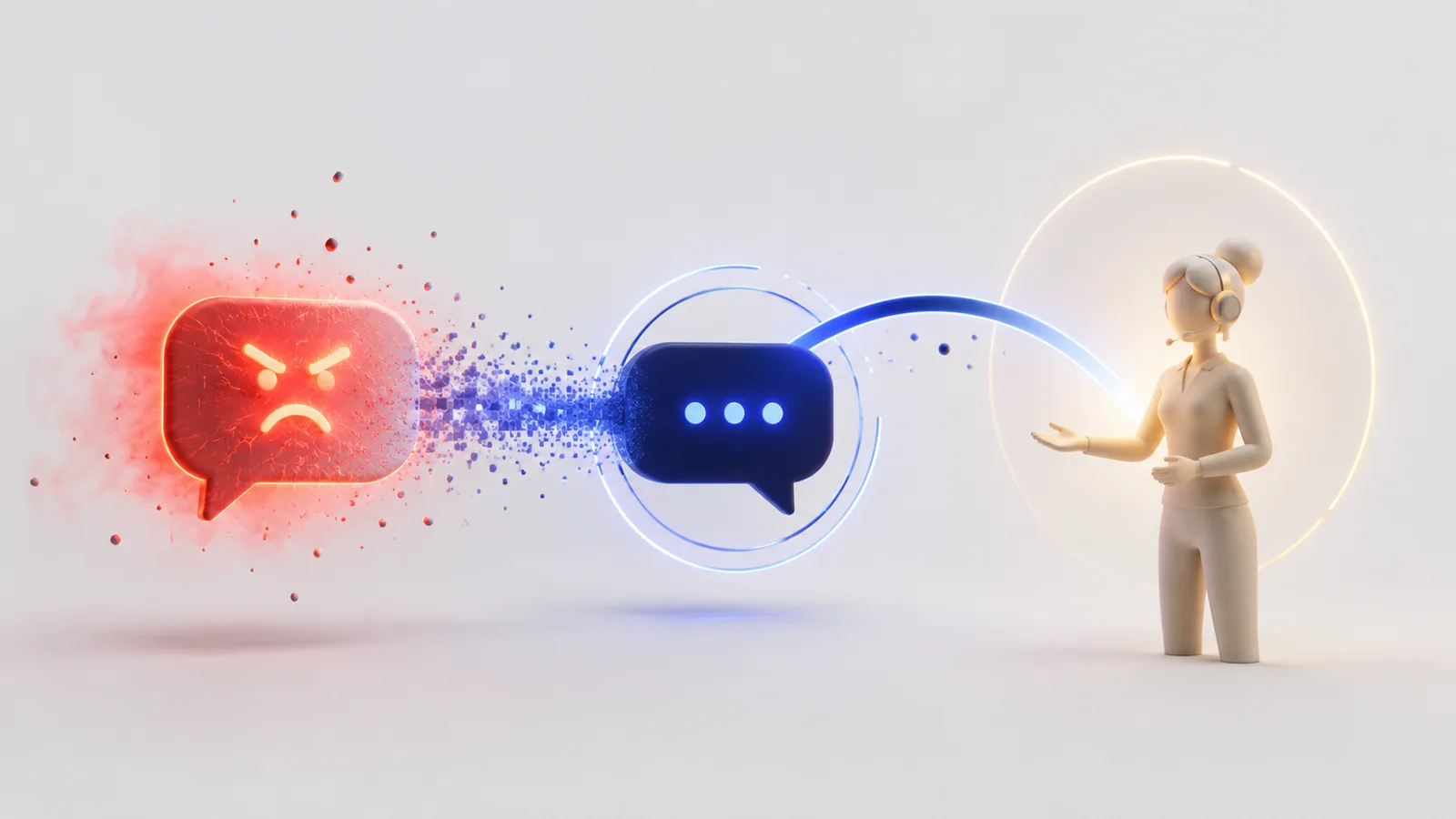
The single most important capability is not empathy, it is recognition. An AI that spots frustration and immediately does two things, responds calmly and hands over to a human with the full history attached, is doing exactly the right job. It is not pretending to feel anything. It is making sure the situation reaches someone who can, quickly, without the customer having to start again.
That handover is the whole game. An escalation that arrives with the transcript, the order, and what was already tried lets a person open it and help in one reply, instead of asking a furious customer to explain themselves one more time.
Why a fast reply takes the heat out
There is an underrated point here. A large part of what makes customers angrier is waiting, the sense of being ignored while their problem sits unread. An instant, calm acknowledgement, even one that says a person is picking this up right now, removes real heat from a situation before a human has even arrived.
So AI helps with angry customers less by being emotionally clever and more by making sure nobody is left waiting in silence, then getting the right person there fast. That is a job it can do around the clock, which is often when the angriest messages arrive.
Frequently asked questions
- Can AI handle angry or upset customers?
- It can acknowledge the problem instantly, stay calm because it has no ego to defend, and collect what a human will need. It should not try to resolve an emotional situation itself, and it must hand over to a person as soon as frustration is clear.
- Should AI respond to customer complaints?
- It should acknowledge quickly so the customer is not left waiting in silence, then route the complaint to a human with the full conversation attached. A canned reply to a genuinely upset person makes the situation worse.
- How does AI detect a frustrated customer?
- From the wording and the pattern: repeated rephrasing of the same question, plainly angry language, or asking the same thing twice. Any of those should trigger an immediate calm response plus escalation to a person.
Where this fits in OctaDezx
Keep reading
- How to roll out enterprise AI customer support with clear ownership
A practical enterprise AI rollout guide: choose a bounded pilot, assign knowledge owners, review permissions, test handoffs and integrate your existing systems. - Will AI annoy your customers? Only if you set it up to
The fear that automation will irritate people is reasonable, because most of us have been on the wrong end of a bad bot. Here is what actually makes customers angry, and how to avoid every one of those things. - Why customers hate repeating themselves, and what fixes it
Being asked to explain the same thing twice is the most common complaint in customer service. It is also completely avoidable. Here is why it happens, and what a shared customer context actually changes.
About the author
The OctaDezx team, Builders of the OctaDezx AI customer care platform. We build OctaDezx, an AI customer care platform used by online stores, restaurants, agencies and clinics to answer customers and take orders around the clock. Everything here comes from running that product and reading real support conversations across those businesses, not from a keyword brief.